


The two illustrations in this post were created by graphic facilitator Dr Pen Mendonça, whose art has become recognisable across communities and sectors. Pen’s imaginative approach to storytelling brings an impactful depth to complex social issues, as her illustrations capture not just the struggle, but also the resilience and creativity of collective action in the face of inequality. Pen creates these illustrations during events while attendees chat and debate, to capture the energy of the conversation in real time. These particular images illustrate the key talking points of a Community of Practice for Migrant-Victim Survivors event which took place earlier this year.
The Community of Practice was formed following a scoping event in April 2024. It is a space for those working with or for migrant survivors, and for migrant survivors themselves, which is dedicated to overcoming the barriers that migrant survivors face when trying to access safety and justice. The Community of Practice is facilitated by Dr Adrienne Yong and Dr Olumide Adisa, who build on and celebrate the work that campaigners across the sector have already carried out. Members of the Community of Practice span the United Kingdom, but come together to strengthen our individual approaches to eliminating the legal discrimination faced by migrant survivors of violence against women and girls, domestic abuse and sexual violence (VAWDASV) in the following ways:
- Develop good practice through knowledge exchange and collaboration;
- Distinguish the needs and experiences of migrant survivors with regard to their rights under the Domestic Abuse Act 2021 and the Istanbul Convention;
- Influence policy change towards amending existing law, or introducing new law, that specifically seeks to protect migrant survivors’ rights and improve access to justice;
- Increase inclusion of those with lived experience in new proposed policies or legislation.
Welsh Women’s Aid are pleased to represent the Welsh voice within the community alongside Bawso, and to support collective action towards achieving justice for all survivors.
But what are the key challenges in the Welsh context?
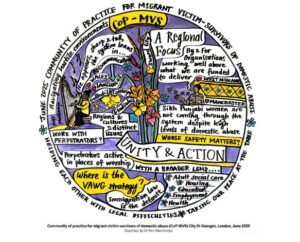
Key Challenges in the Welsh Context
Migrant survivors in Wales face many of the same challenges as those living in other parts of the UK, including language barriers and threats of anti-migrant violence, but some challenges are amplified by regional variations in service provision. Despite Welsh Government commitments set out in the VAWDASV Strategy 2022-2026 and the Nation of Sanctuary Plan, there are still gaps in protection which contribute to keeping migrant survivors trapped in abusive situations. Addressing these inequalities is essential to ensure that the Welsh Government’s vision of safety, support, and empowerment is realised for all survivors, regardless of immigration status.
Misinformation about Support Entitlements
Although immigration is not devolved, there are some key legislative differences between Wales and England when it comes to social service support entitlements for migrant survivors who have No Recourse to Public Funds (NRPF). However, there is an inconsistent understanding of legislative duties across local authorities, resulting in wide variations in social service support across Wales. This generates a ‘postcode lottery’, and increases the risk of migrant survivors becoming homeless or destitute if they leave an abuser. Welsh Women’s Aid has raised the right to safe and adequate housing for survivors with NRPF on a number of occasions, and found that a lack of understanding of the Social Services and Well-Being (Wales) Act 2014 is contributing to local authorities failing to meet their duties to many survivors. This is why in our manifesto for the 2026 Senedd election we are asking the next Welsh Government to develop expert-led guidance for local authorities to address responsibilities of the safe and adequate housing of survivors with NRPF.
If you are a specialist VAWDASV service who needs support to navigate this particular challenge, you can access Welsh Women’s Aid’s Toolkit on the Rights of VAWDASV survivors subject to Immigration Control or contact us directly for further support.
Data Sharing
Research shows that migrant survivors are less likely to confide in the police due to communication barriers and fear of discrimination. On top of this, even though the Istanbul Convention requires that survivors can access protection irrespective of their immigration status, there is evidence that every police force in Wales has referred domestic abuse victims to Immigration Enforcement. Data sharing between statutory services, the police and the Home Office is therefore a significant barrier to disclosure, resulting in many migrant survivors being trapped in abusive situations due to fear of detention or deportation. Even when there is no risk of deportation, perpetrators may weaponise a survivor’s immigration status by making them believe that there is a risk of deportation as a form of coercive control. Research from Latin American Women’s Rights Service (LAWRS)’s Step Up Migrant Women campaign found that over 60% of migrant survivors were threatened with deportation by their abuser if they sought help. Additionally, there is a significant decline in options for migrant survivors to be able to access the legal advice needed to navigate this threat, with 60% of Wales’ immigration legal aid offices having closed in just over 5 years. This is why Welsh Women’s Aid strongly support the implementation of a firewall between public services and the Home Office, to ensure survivors do not feel at risk of further harm when disclosing abuse.
Anti-Migrant Threats
Welsh Women’s Aid are also deeply concerned by the growing trend of far-right campaigners exploiting violence against women and girls as a method to cause division and harm marginalised communities across Wales. Anti-immigration protests have used VAWDASV as an excuse to share hatred and spread fear among communities, resulting in migrant survivors facing increased risk of discrimination, and producing further barriers to disclosing abuse. A true commitment to ending violence against women and girls means standing against all forms of oppression, and these harmful narratives divert attention from the structural nature of VAWDASV. This is why Welsh Women’s Aid and Welsh Refugee Council are currently working together to release a joint statement which states that we, and many of our members, wholly reject anti-migrant campaigners’ use of VAWDASV to incite fear, create division, and promote harmful stereotypes.
These are just a few of the challenges that migrant survivors and the services supporting them face, but it’s also worth remembering that beyond these challenges, there are people working hard every day to bring about meaningful change. Collaborative working (like that which takes place through the Community of Practice) helps us to turn shared learning into action. It brings us closer to a system that recognises the strength and resilience of migrant survivors, and works collectively to remove the barriers they face, so that no survivor is left without support because of their immigration status. Through collaboration and compassion, we can create a Wales where every survivor, regardless of background, has a path to safety, dignity, and justice.
Community of Practice for Migrant Victim-Survivors (CoP-MVS) Information & Resources:
If you work in the area of domestic violence and immigration law (either as a practitioner or a researcher) and are interested in joining the Community of Practice for Migrant Victim-Survivors, pleasecontact: [email protected]
The Community of Practice has also produced a number of resources which you may find useful. For example, Dr Sabrina Germain & Dr Adrienne Yong spoke to Jas Bhatoa (Senior Legal Officer at Rights of Women) and produced this podcast episode, which discusses how legislation disadvantages migrant survivors. The proceedings of the first Community of Practice conference have also been captured in two documents: an academic policy paper which summarises the legal, practical and social issues discussed, and a conference summary, intended as a short introduction to the challenges facing migrant survivors of domestic abuse.
Image by www.penmendonca.com , LinkedIn: Dr. Pen Mendonca LinkedIn. Pen’s illustrations are used here with her permission. Please ensure she is credited whenever her work is shared and tagged appropriately on social media. Each acknowledgement helps sustain her practice and protects the years of skill, storytelling, and artistry that make her work so distinctive.
Written by Amber Patterson, Services Development Officer, Welsh Women’s Aid